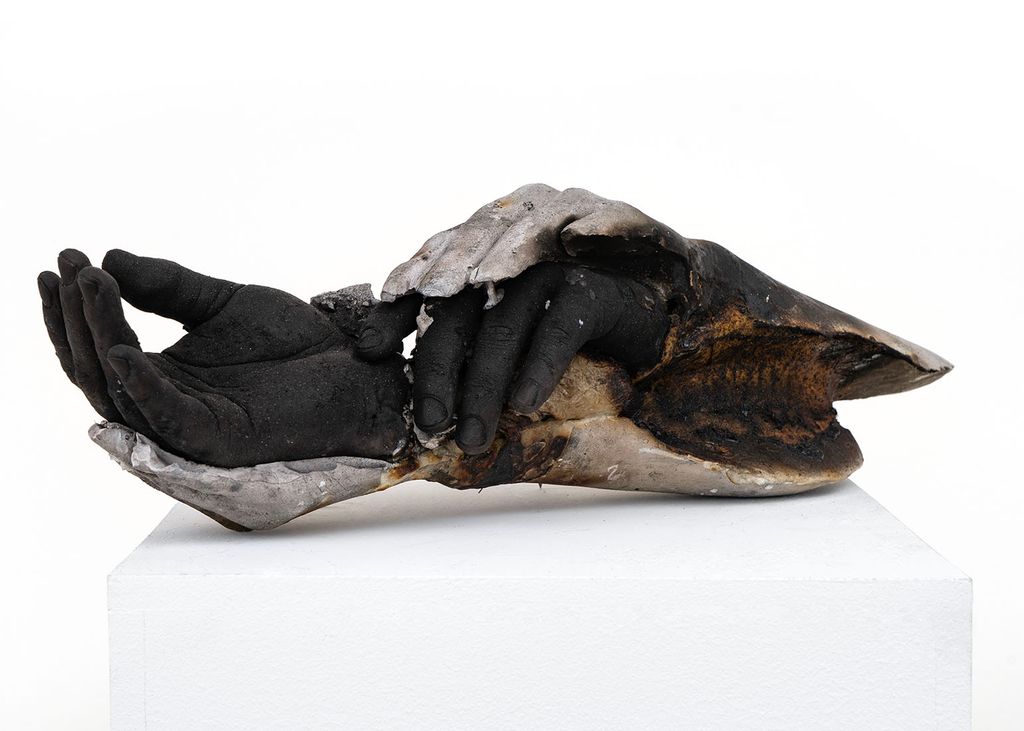
Chiffon Thomas, Untitled, 2023
Chiffon Thomas (b. 1991, Chicago, IL; lives and works in New York, NY) is a multidisciplinary artist whose practice understands the body as an architectural and archival site, a structure in which memory, trauma, and material transformation accumulate in uneven layers. Working through casting, stitching, burning, carving, and assemblage, Thomas creates sculptural forms that operate like hybrid infrastructures, binding corporeal gesture to architectural ruin. Their work is shaped by a belief that identity is an ongoing construction, continuously reorganized by historical pressure, domestic displacement, and the emotional sediment of lived experience. Thomas frequently incorporates fragments from demolished or abandoned homes—such as ventilation grates, insulation, woodwork, and architectural debris—which become prosthetic extensions of the figure. These vessels hold both personal and collective residue. In these works, the domestic realm assumes the role of a psychological engine, tasked with navigating the complexities of queer and Black embodiment, memory-keeping, and survival.
Thomas’s sculptural language foregrounds how corporeal form and architectural fragmentation intertwine as parallel structures of endurance. Just on the heels of a recent major acquisition by the Dallas Museum of Art’s permanent collection, the work included here highlights Thomas’s commitment to exploring the tension between exposure and protection, collapse and coherence. Across their practice, the figure does not appear as a complete entity but as a system of seams, thresholds, fractures, and reinforcements—a body in perpetual negotiation with its histories.
Thomas’s sculptures operate through a logic of suturing. Cast hydrocal, torched resin, silicone skins, charred burlap, and exposed armatures reveal process as an open wound rather than a concealed mechanism. Burned edges become apertures, seams function as both vulnerable and load-bearing points, and interiors are shown with the density of architectural cross-sections. In Thomas’s hands, the body becomes a built environment—one shaped by forces that exceed its control, yet reinforced by the gestures that hold it together.