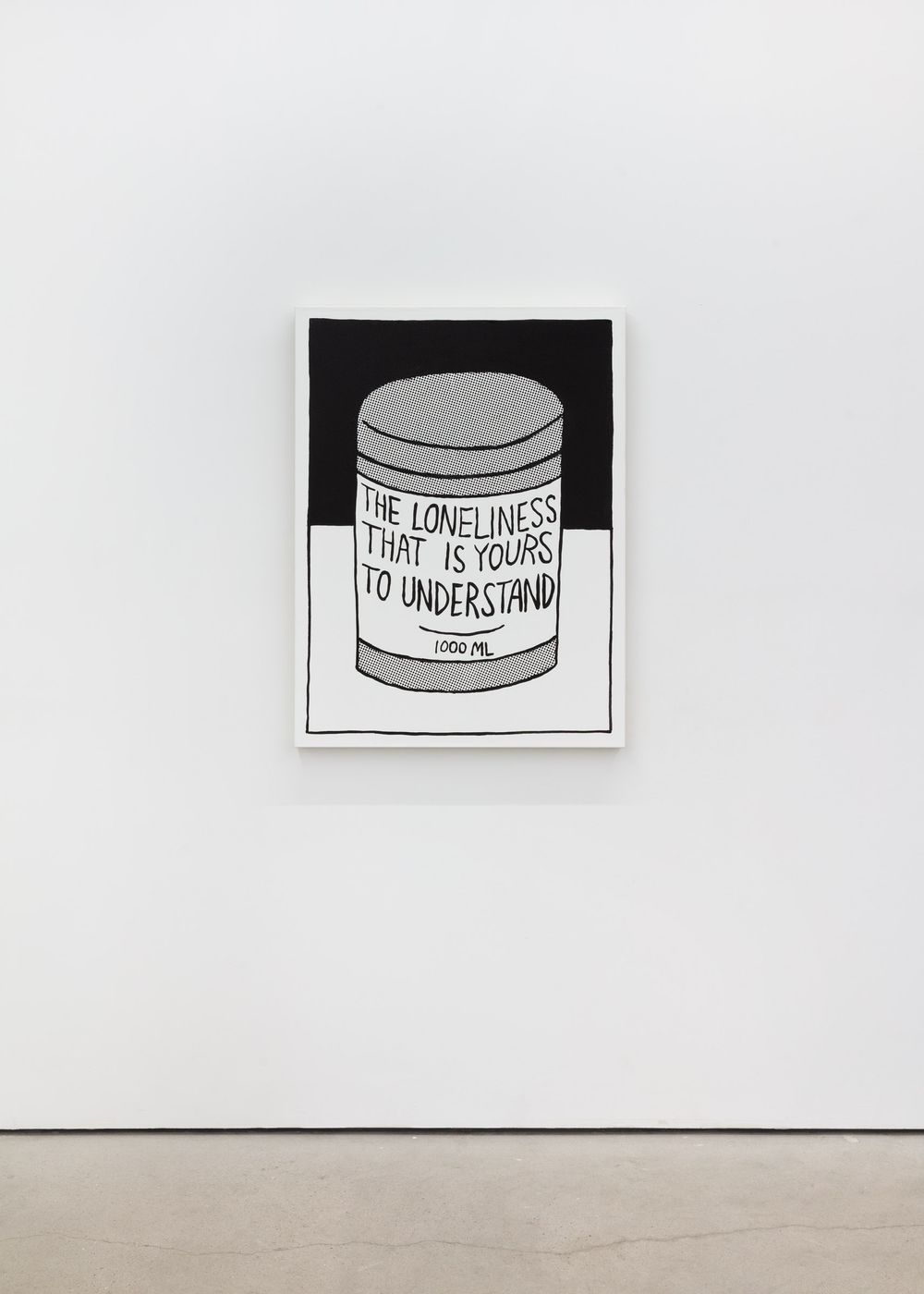
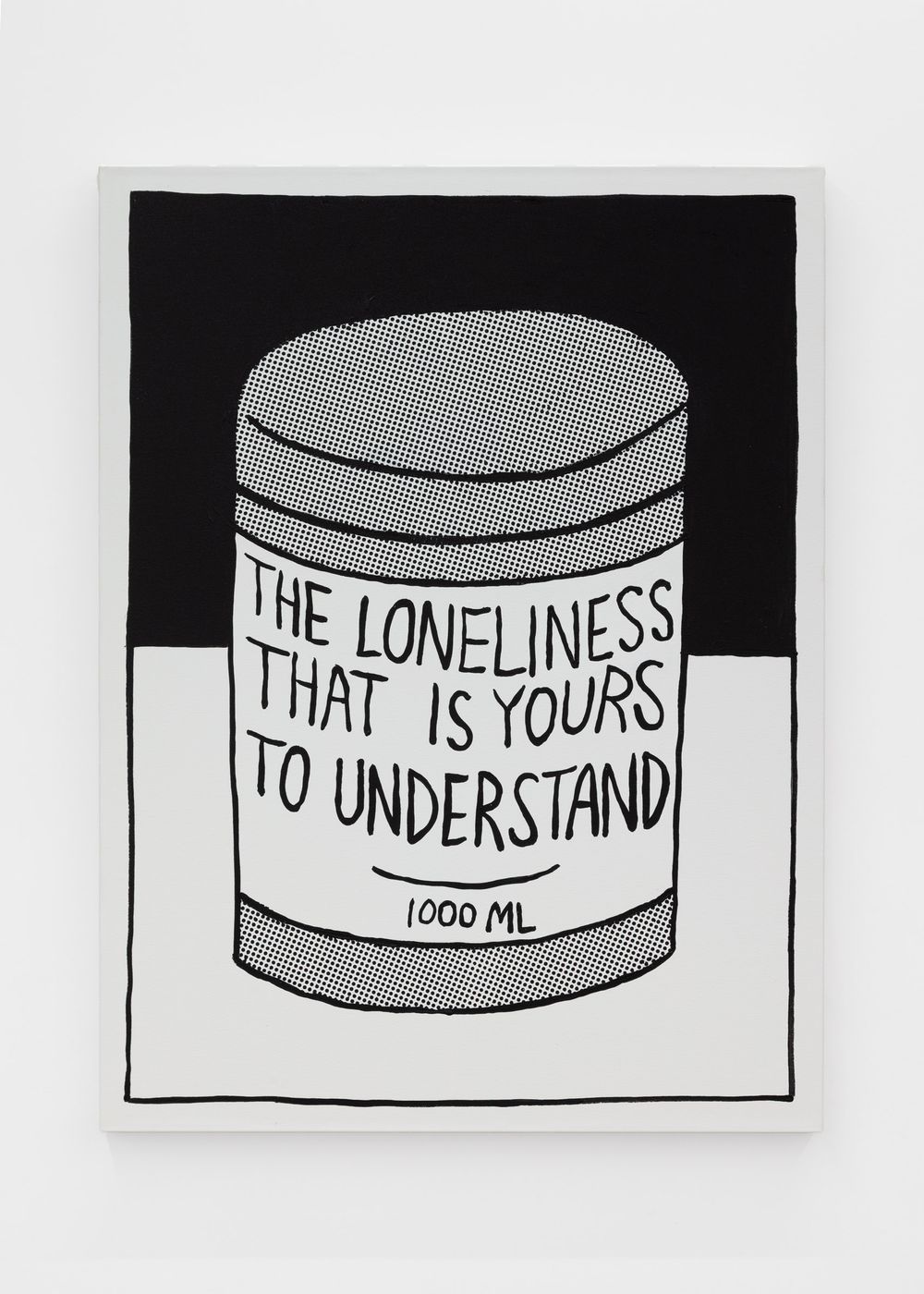
Walter Scott, The Loneliness that is Yours to Understand (1000ml), 2025
Acrylic on canvas
40 × 30 × 1 inches
In this new series of paintings and drawings, Scott plays with tropes of artistic misery. The nuances and struggles of artists, alongside satirical depictions of the art world, have both been ongoing interests for Scott. The series also functions as a series of portraits of psychological states, depicting a spectrum between comedy and tragedy. These works telegraph from a slippery place where the act of making and the act of being are exhilaratingly indiscernible from each other.
Earlier this year, Scott’s debut solo exhibition with the gallery, A Shape in the Living World (Hunt Gallery, Toronto), marked a pivotal shift in his practice toward narrative-based abstraction. The exhibition in its entirety was acquired by the Gochman Family Collection, a significant private lending collection known for its commitment to supporting contemporary Indigenous artists.
At NADA Miami, Scott will present a focused selection of paintings that build on the ideas introduced in A Shape in the Living World. Widely acclaimed for his graphic novel series Wendy, Scott translates his distinctive visual language into painting, drawing on comic tropes—borders, thought bubbles, and expressive gestures—to examine how symbols shape cultural understanding. Through this formal language, he constructs spaces that are at once humorous and existential, prompting viewers to reconsider how narratives are built and received.
“My intervention on the image is symbolic and conceptual, for me. For instance, one of the paintings is taken from a panel of Wendy, lying in bed surrounded by all her writing materials and empty wine bottles and coffee cups. So in Photoshop, I removed her so the bed was just empty,” said Scott about his painting’s connection to his previous work. “I knew that there was a figure there before, but now the figure was absent, and all that was left was ephemera of the neurotic life of a writer.
I thought the empty bed was more poetic and maybe more engaging, ironically, as a painting.”
Scott’s approach parallels the work of Ad Reinhardt, who used both satire and abstraction to encourage close looking and critical thought. Influences from Mike Kelley, Aidan Koch, Roy Lichtenstein, and David Shrigley can be traced in Scott’s layering of text and image, often pairing stream-of-consciousness writing with unexpected compositions. The viewer is invited to assemble these fragments into new narratives, uncovering the subtle mechanics of meaning-making.