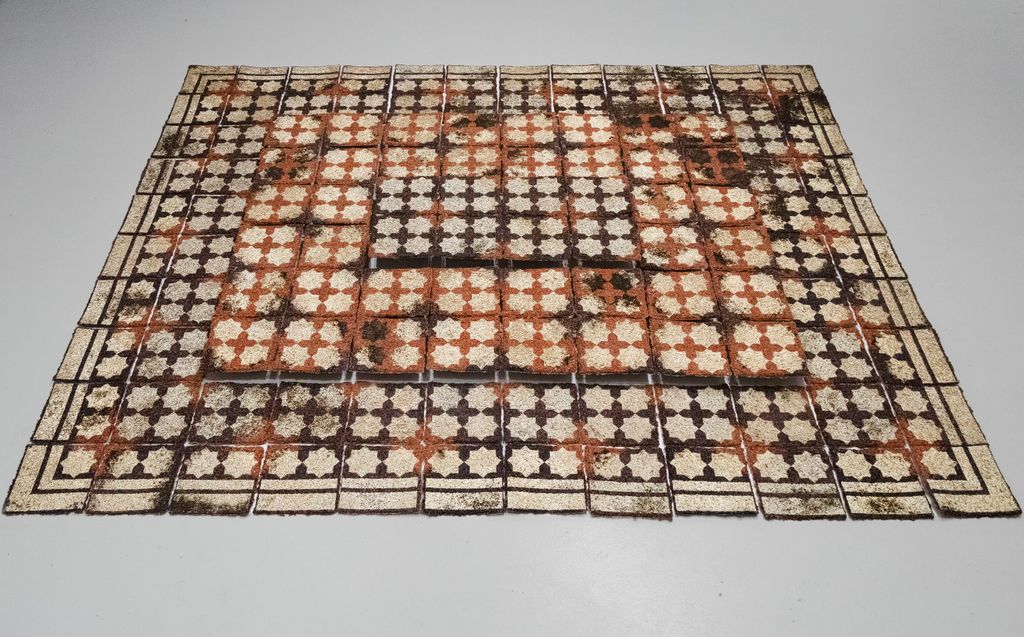
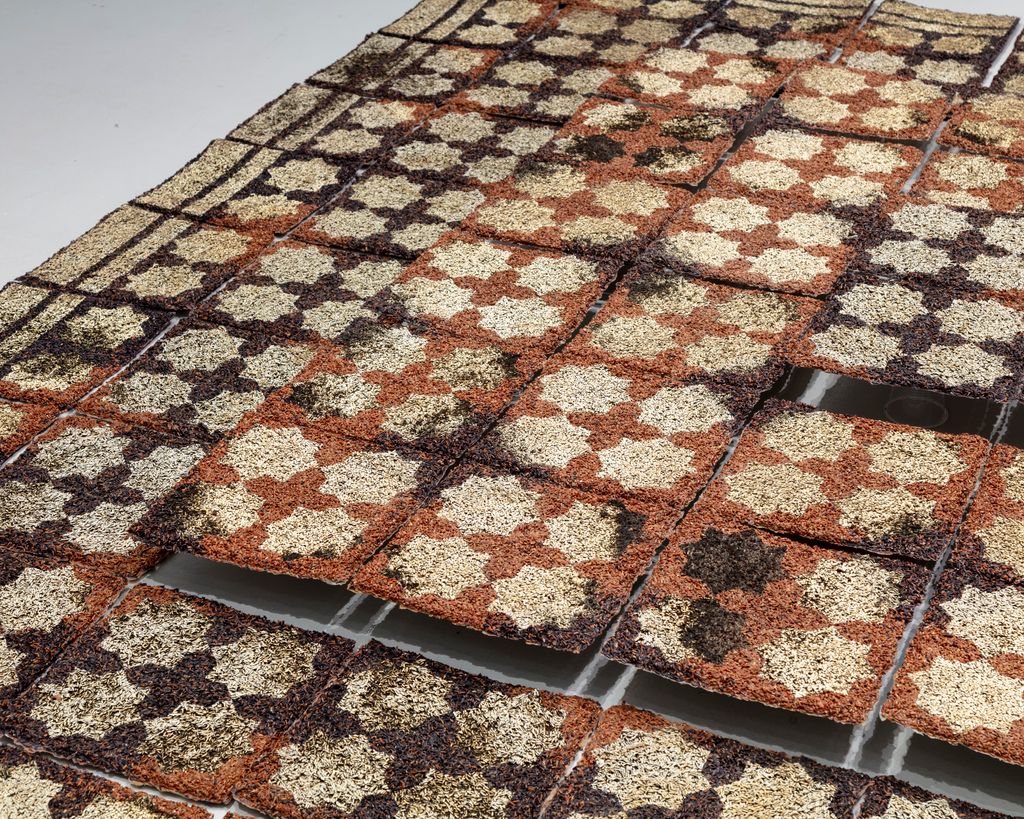
Purvai Rai, Shifting fields, 2025
Laser etching, red and black rice on panel
120 × 144 inches
Purvai Rai (b. 1994, New Delhi, India; lives and works between New York and New Delhi) is a multimedia artist whose practice maps the entanglements between land, lineage, labor, and ecological precarity. Working across sculpture, textiles, drawing, and bookmaking, Rai grounds her work in the agricultural and architectural histories of her ancestral village of Nawanpind in Punjab, a landscape shaped by monsoon cycles, colonial land interventions, forced crop shifts, and ongoing political protest. She received her MFA from the Yale School of Art in 2025 and her BFA from the Srishti Institute of Art, Design & Technology in 2017. Her work has been exhibited at Perrotin, New York; Nunu Fine Art, New York; THK Gallery, Cape Town; and Gallery Espace, New Delhi, and is included in the collection of the Kiran Nadar Museum of Art (KNMA), India. She was a 2024 Artist-in-Residence at the Henry Moore Foundation in the United Kingdom.
(120 "rice tiles" total) Purvai Rai’s investigation into agricultural architecture emerges prominently in Shifting Fields, 2024–2025, a floor-based installation composed of 120 laser-etched tiles made with red and black rice and adhered to wood panel. The work recalls the Haveli built by her ancestors in 1916 as a granary and distribution center for over 200 acres of farmland in Nawanpind. Its spatial logic — a grid designed for organizing agricultural yield — became destabilized following the Indian government’s 1970s Land Ceiling Act, which fragmented ancestral landholdings and reshaped longstanding economic structures. In 2007, Rai’s mother restored the Haveli, installing geometric-patterned tiles sourced from local manufacturers. Shifting Fields echoes this restorative gesture through its rhythmic geometry, transforming the booth floor into a site of memory and return.